- OSINT
- open-source intelligence (OSINT - wikipedia)
The Pyramid of Pain
Knowlesys - OSINT realization - looks like resource which describes osint in general
Internet is based on:
- Hierarchy of DNS names (tree hierarchy)
- RIPE databases - exists 5 regions (Europe, Central Asis; North America; Asia, Pacific; Latin America, Caribbean; Africa) each region has its own ip-address pools and each region gives sub-pools to other instances (company or provider or country or …)
- Set of autonomous systems - AS. (these has no hierarchy)
- SSL certificate chains
- by what? the file was created/changed - software type (e.g. MSWord, ImageMagick, …)
- by whom? the file was created/changed - username, impersonalization
- computer name, where file was created/changed
- when? the file was created/changed - date/time
- where? the file was located - path disclosure
- e-mail addresses
- ip-addresses
- dns-names and subdomains
Most popular assests searched for compromisation:
- an unpatched server connected to the Internet
- an individual
- OSINT Framework - awesome collection of various tools for OSINT (Open Source Intelligence)
- publicwww - find any alphanumeric snippet, signature or keyword in the web pages HTML, JS and CSS code
- nerdydata.com - quality leads from all over the web
web-spidering:
- BlackWidow - web-spider
/usr/share/BlackWidow/blackwidow -d example.com -l 5 - Photon - light web-spider
photon.py -u http://example.com -l 5 -d 0 -t 10 - blacksheepwall (based on CommonCrawl - grep the internet)
blacksheepwall -cmn-crawl CC-MAIN-2018-13-index -domain sberbank.ru
online services:
IP, reverse IP, whois, NS, MX, PRT - history analysis, …
search whois history, etc.:
active actions (port scan, …) on behalf of other’s services:
- subresolve - resolve and quickly portscan a list of sub-domains
- Subdomain enumiration
- process of exposing subdomains of one or more domains
Categorial/concrete tools/attacks:
- CloudFail - utilize misconfigured DNS and old database records to find hidden IP’s behind the CloudFlare network
python cloudfail.py --target rublacklist.net
- domains-from-csp - a script to extract domain names from Content Security Policy(CSP) headers
python csp_parser.py -r http://example.com
Everything beneath can be done faster if you will use frameworks and other complex tools
Subject Alternative Name (SAN) - X509 extension to provide different names of the subject (subdomains) in one certificate
Even if there is non-resolvable subdomain, probably admins use the same certificate for intranet connections.
Forward DNS
zone transfer - does DNS server expose a full DNS zone? (via AFXR) (AXFR zone transfer scan (by sergeybelove))
dig axfr zonetransfer.me @nsztm1.digi.ninja
host -t axfr zonetransfer.me nsztm1.digi.ninja
host -avl zonetransfer.me nsztm1.digi.ninja
nslookup -query=AXFR zonetransfer.me nsztm1.digi.ninja
fierce -dns zonetransfer.mednsrecon -a -d zonetransfer.me
NSEC walking attack - enumerates DNSSEC-signed zones
Take your DNSSEC with a grain of salt
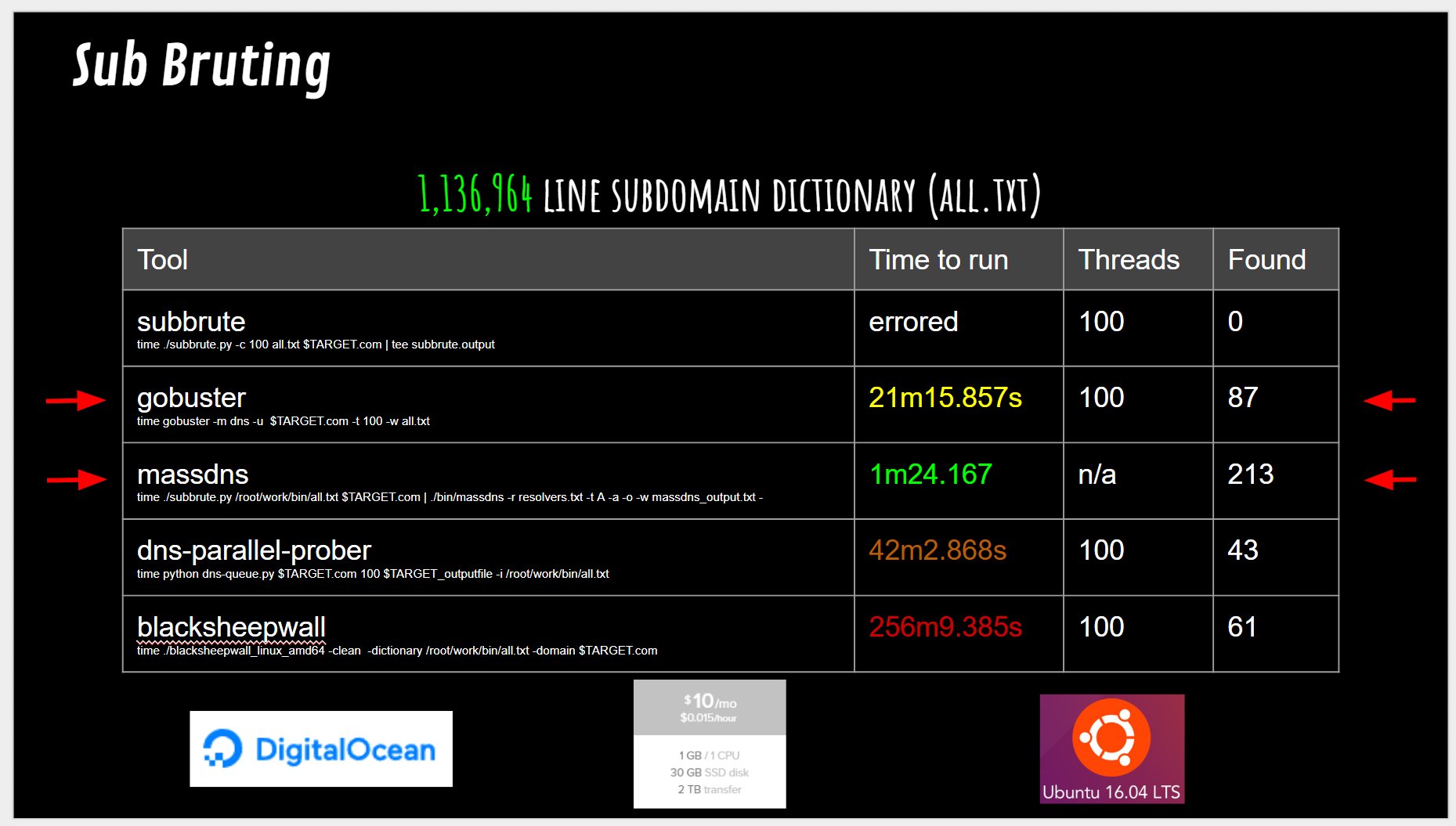
Comparison of subdomain bruteforce tools: massdns, gobuster, dns-paraller-prober, blacksheepwall, subbrute (pic)
SecLists - check bruteforce lists
compiled GIANT subdomain wordlist (march 2018)
- massdns
- fierce
fierce -dns zonetransfer.me
fierce -dns zonetransfer.me -wordlist /path/to/wordlist.txt - for custom wordlist - subbrute
- dnsrecon
dnsrecon -d example.com -D /usr/share/wordlists/dnsmap.txt -t std --xml dnsrecon.xml
dnsrecon.py -n ns1.example.com -d example.com -D subdomains-top1mil-5000.txt -t brt nmap --script dns-brute --script-args dns-brute.domain=domain.com,dns-brute.threads=6,dns-brute.hostlist=./sub1000000.lst- SDBF - smart DNS bruteforcer (paper)
- DNSenum
- gobuster - tool for URL and DNS bruteforce
- manually check existance of
dev.example.com, beta.example.com, db.example.com, admin.example.com, …
Technique works through bruteforcing bucket names and searching for public buckets.
The social engineering framework - a searchable information resource for people wishing to learn more about the psychological, physical and historical aspects of social engineering.
Social engineering questions: who? (clients/employees), purpose? (awareness assessment, checking Incident Response Center, get confidential information, …), intruder model (insider/outsider), when? (at night, at the end of working day, …)
- SET - the Social-Engineer Toolkit
- urlcrazy (kali) - tool for generating and autochecking availability of domain names with similar spelling
dnstwist - domain name permutation engine for detecting typo squatting, phishing and corporate espionage - GoPhish - opensource phishing framework
King phisher - phishing campaign toolkit
Fierce Phish - other phishing framework (looks young) - evilginx2 - standalone man-in-the-middle attack framework used for phishing login credentials along with session cookies, alowing to bypass 2-factor authentication.
evilginx 2 - next generation of phishing 2FA tokens - spoofbox.com - spoof e-mails, messangers, …
For spam delivery:
- mailgun.com - “powerful APIs that enable you to send, receive and track email effortlessly (10,000 emails free every month)”
- sendpulse.com - “maximizing open rates automatically with Artificial Intelligence, Hyper-personalization, Predictive analysis for email, SMS, Web Push, SMTP”
- mail-tester.com - first send your email, then check your score
search for phishing sites: altdns - generates permutations, alterations and mutations of subdomains and then resolves them
- configure domain (example.com TXT record “v=spf1 +a +mx -all”), mail-servers, spam-filters, sandboxes, etc.
- monitor anomalies
- employee training
- carry socio-technical testing
- FOCA (Fingerprinting Organizations with Collected Archives) - search for company’s documents (through google, yandex, bing, rambler, etc.) and afterwards exports and consolidate metadata (FOCA not maintained anymore, but still brilliant)
- Belati - the traditional swiss army knife for OSINT (FOCA’s good/better alternative)
metagoofil - extracting metadata from public documents found by google
metagoofil -d example.com -t pdf -l 100 -n 25 -o example -f example.com.html - scan for documents from a domain (-d example.org) which are PDF files (-t pdf), searching 100 results (-l 100), download 25 files (-n 25), saving the downloads to a directory (-o example) and saving the output to a file (-f example.com.html)
- snitch - automate information gathering process for specified domain
exiftool -jk - tool for extracting metadata from files
Metadata can be treated as bigdata: splunk (offitial site)
Articles:
- email headers may contain ip-addresses from internal companie’s infrastructure
- Lookup github.com, bitbucket.org and other open control version systems for client’s backups, configs, dev code, etc.
GitMiner - tool for advanced mining for content on Github


Comentários
Postar um comentário